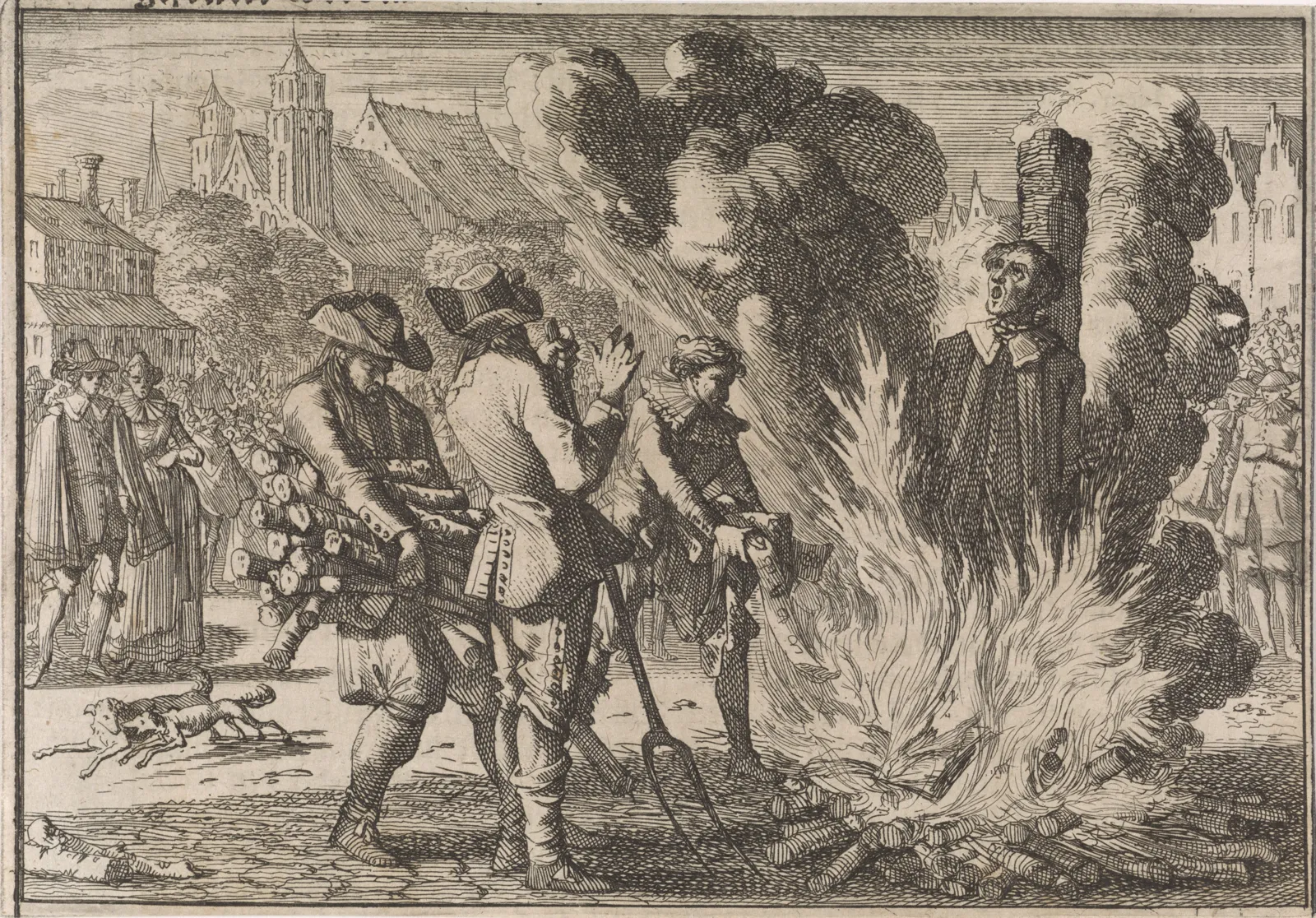
A priest named Urbain Grandier was burned alive at Loudun on 18th August 1634, having been convicted of bewitching a convent of Ursuline nuns. He never confessed. By the standards of the day the case was vast in scale: sworn depositions, printed pamphlets, a royal commissioner, and crowds who came from far and wide to hear nuns speak in the voices of devils.
Nearly all writing on Loudun today views the town from the outside. Aldous Huxley published The Devils of Loudun in 1952. John Whiting adapted it for the stage in 1960, and Ken Russell later brought it to the cinema. In each version the prioress, Jeanne des Anges, is an object of scrutiny: a face in a crowded church, a name in a courtroom, a patient.
She also wrote it all down. And the book she wrote is odder, and far more personal, than any of the versions built on top of it.
A nun with something to confess
Jeanne de Belcier was born in the early 1600s to a noble family from Saintonge. The date usually given is 1602, although one catalogue lists 1605, and the age she gave under oath in a 1637 deposition suggests about 1604. On professing as an Ursuline at Poitiers on 8th September 1623 she adopted the name Jeanne des Anges, meaning Jeanne of the Angels. Some years afterwards she campaigned energetically to be included among the nuns sent to establish a house at Loudun, a town with a substantial Protestant population, and she concedes that such insistence was not the conduct expected of a good nun. Following the superior's transfer elsewhere, Jeanne, young and in her own words inexperienced, took over as prioress.
Her own account of those early years is unsparing, and deliberately so. She read widely in order to appear clever. She passed entire days talking at the parlour grille. She made herself useful to those above her "by a thousand little wiles of mind". She wrote on instruction, as a confession, and that habit of dissecting her own motives runs through every page that follows.
The autumn of 1632
She describes the episode with remarkable brevity. "Our Lord permitted a spell to be cast on our community by a priest named Urbain Grandier, parish priest of the principal parish of the town." Within a fortnight, she claims, all the nuns in the house had been afflicted, "some by possession and others by obsession". In the terminology of the period, possession signified a demon operating from within the body, while obsession meant an attack from outside.
Here is a detail that later readers often pass over. In a letter to the Queen in 1638, Jeanne stated that the nuns had in fact never set eyes on Grandier and bore him no ill will, and that it was the devils who named him every time. And yet in the memoir she calls him a wretch who came to the convent at night, saying that while he was absent she burned with love for him, and that when he turned up she loathed him "more than the devil". The nineteenth-century doctors who first put her text into print fastened on this: since she had never seen him, they contended, the nocturnal visitor could only have been a hallucination. It is easy to see how one and the same sentence can support two entirely opposed interpretations.
Grandier was hardly a model cleric. An able but combative priest, he had a name for womanising and for alienating people in the town. The Bishop of Poitiers found him guilty of immorality in 1630; he lodged an appeal and the Archbishop of Bordeaux cleared him a year later. A royal councillor, Jean Martin de Laubardemont, then came to Loudun on Crown business, namely the demolition of the town's castle, and returned at the end of 1633 carrying a commission to put Grandier on trial. He was arrested that December. Historians continue to debate how far Cardinal Richelieu was involved. Jeanne herself never poses the question: for her, the Cardinal was simply "our protector".
Seven demons, seven faults
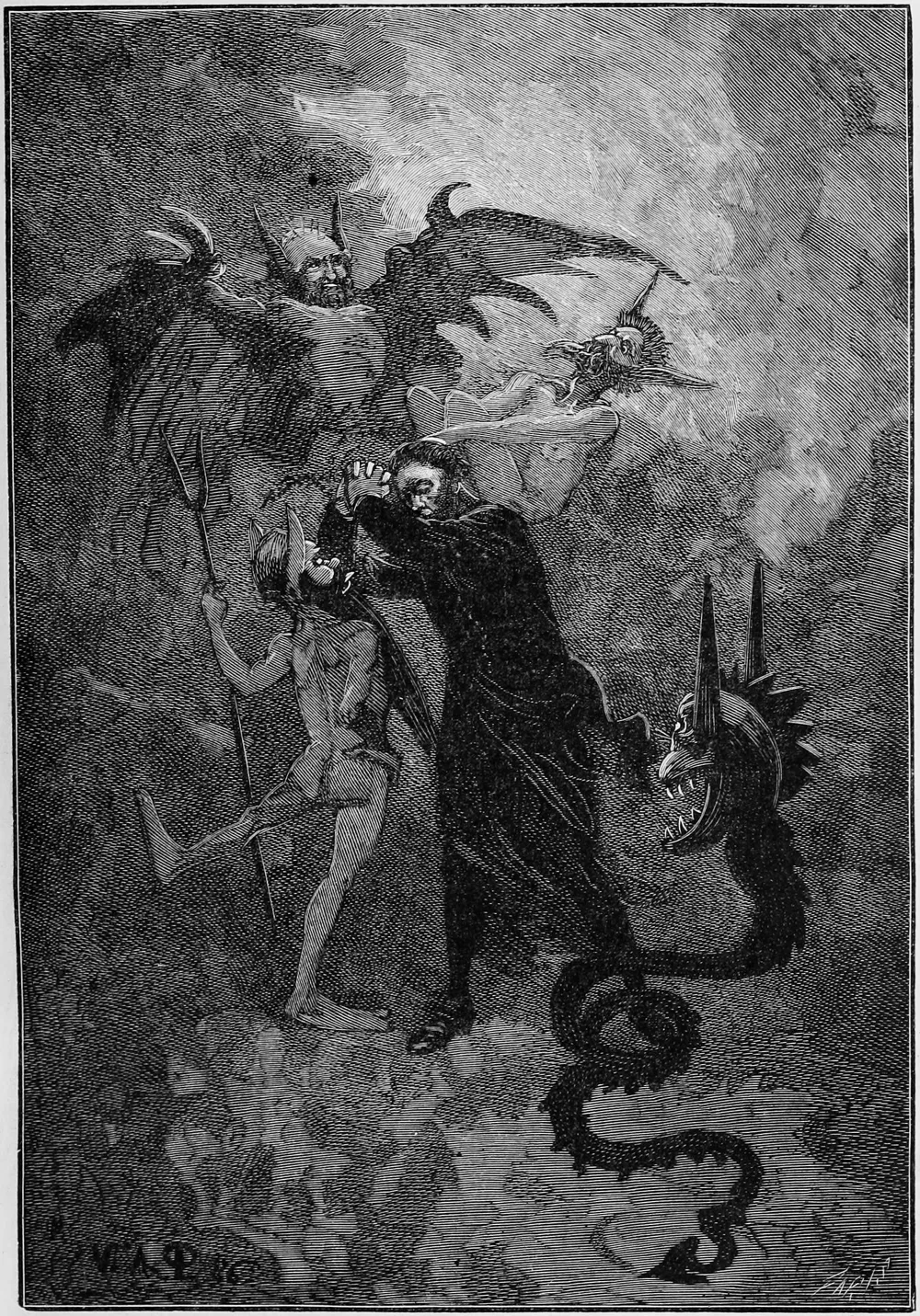
At this point her book takes an odd turn. Jeanne reckoned there were seven demons within her body, and she noted with care the role played by each. Asmodeus, who led them, assailed her mind with impure thoughts. Leviathan operated through her pride and her desire to dominate. Behemoth made her heart hard and filled her with hatred of God and of her vows. Isacaaron, the most brutal, went after her chastity. Balaam provoked a careless levity. Gresil and Aman were cast out so soon that she could barely distinguish between them.
Consider what that list amounts to. Every devil corresponds to a failing she had identified in herself. Theological teaching on demons and a nun's self-examination merge into one, with no boundary drawn between them. She takes the possession to be genuine. Yet she keeps probing the extent to which she brought it on herself, and one sentence above all has stayed with readers: "it is we ourselves who very often supply him with the weapons with which he makes war on us."
The knife in the small room
The book hinges on a Jesuit, Father Jean-Joseph Surin, who took over as her director in 1634. Her plan was to reveal as little as possible about her soul to him, and for several weeks she succeeded. Then 2nd January 1635 arrived. Isacaaron had persuaded her that she was pregnant. Fearing what people would say, she took a knife and water into a small room, intending to cut open her side, baptise the child and die. She recounts being flung to the floor, the knife being taken from her hand, and a voice from the crucifix on the wall ordering her to turn back. The evidence of the pregnancy disappeared shortly afterwards, before a bishop and physicians, in a great vomiting of blood.
At that point Surin adopted an unexpected position. Setting himself against the majority of his fellow priests, he advised her to stop blaming the demons for her afflictions and to turn the punishment on herself instead. This she did, with a rigour she sets down without pride and without excuse: a year on a bed of boards, the discipline several times daily, an iron belt studded with spikes for almost six months, and nights spent outdoors in the snow.
The other nuns who were possessed gave her the nickname "the devout devil". The demons departed one at a time, and each had to leave a sign behind. Leviathan left on 5th November 1635, marking her forehead with a bloody cross that remained for three weeks.
Names written on a hand
The names were what brought her renown. On her left hand Balaam inscribed Joseph, while Isacaaron placed Maria above it. Behemoth, the final one to depart, wrote Jesus and Francis de Sales on Saint Teresa's day in 1637. A glove covered them. By her account, her guardian Angel restored the names each time they faded, accompanied by a gentle tingling and a sweet fragrance.
The world was eager to see them. In Tours, physicians judged their names to lie outside nature. In Paris, surgeons scrubbed at them with hot cloths, waters and oils, to no effect. The Cardinal of Lyon attempted to cut them off with scissors, then called a surgeon to shave them away, halting only when she protested that her superiors had sanctioned no such experiments.
The road show of 1638
Behemoth had vowed to depart only at the tomb of Francis de Sales in Annecy, Savoy. In the event he left at Loudun, yet Jeanne and Surin had pledged to make the journey, and in 1638 she did so. She set out from Loudun on Monday 26th April accompanied by two nuns and the convent's confessor. At Tours, between four and seven thousand people came daily to see her hand. At Blois the inn's doors were broken down. In Paris she was displayed at a ground-floor window from four in the morning until ten at night, her arm resting on a cushion and her hand extended towards the street, until she collapsed on the floor.
The Archbishop of Paris received her, as did Richelieu, who was ill in bed at Ruel: he bared his head before the relic, kissed it and donated five hundred écus towards the journey. Queen Anne of Austria, six months pregnant with the future Louis XIV, also received her. On 29th May 1638 the King came in person to see her hand, talked with her for an hour and set out her route to Savoy. It makes striking reading: a woman who started out as the prioress of a small, impoverished convent was treated like a living relic by the most powerful figures in France.
Why the doctors got there first
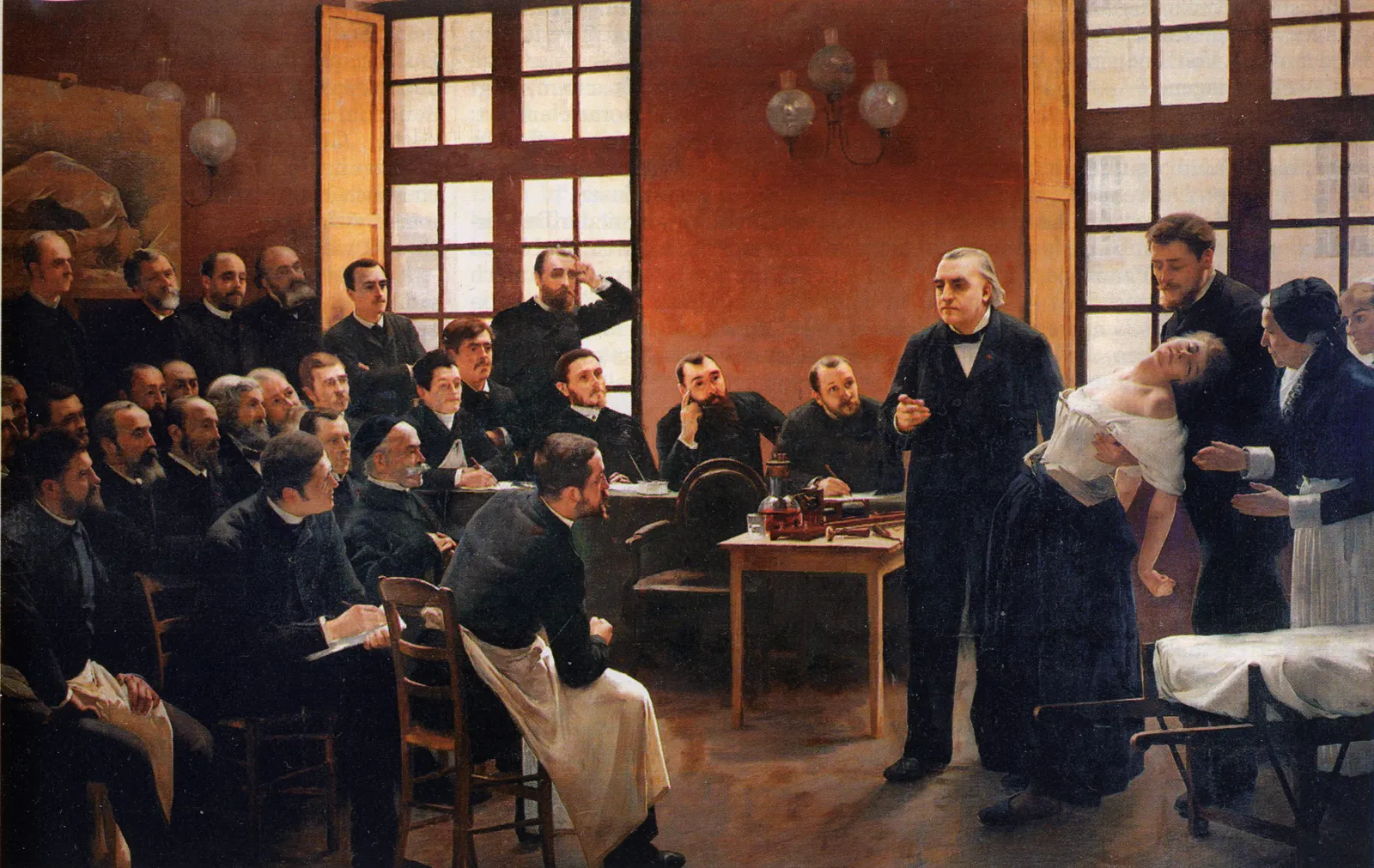
For over 200 years her manuscript was kept at the municipal library in Tours. It was published in 1886 by Gabriel Legué, already the author of a book on Grandier, and Georges Gilles de la Tourette, a student of the eminent neurologist Jean-Martin Charcot at the Salpêtrière hospital in Paris. The preface was supplied by Charcot. The title framed the reader's response before a single page was turned: autobiographie d'une hystérique possédée, the autobiography of a possessed hysteric.
In their view, everything she presented could be "perfectly explicable, today as in the past, by medical knowledge alone". The convulsions were set down as the stages of Charcot's hysterical attack; the visions as hallucinations; the marks on her hand as the effect of suggestion upon the skin. On the phantom pregnancy, they remarked: "A pregnancy born of a hallucination and cured by a crisis is evidently a hysterical pregnancy." They were not, however, merely dismissive. Her text was copied out with care, its seventeenth-century spelling retained, and without their work there would be no book to read at all. Their diagnosis has itself since turned into a historical curiosity, given that hysteria in Charcot's sense is no longer a medical category.
What the later letters add
Her memoir breaks off with neither signature nor date at a cure on a Christmas night, most likely in 1638. That was not the end of the story. In 1643, after more than four years with no director, she wrote to another Jesuit, Jean-Baptiste Saint-Jure, and the extracts from that correspondence, which continue through the 1640s and beyond, reveal what the possession left in its wake. She continued to see her Angel, a white-clad youth of around fifteen who reproved her for her faults. She was tormented by demons that beat her, and by pains in her heart where, from Good Friday 1645, the instruments of the Passion were said to be engraved, along with copious vomitings of blood. She also ran a convent. She closed the parlours to idle visitors and was told she was too strict. In 1646 she sought to avoid re-election as prioress; the first election was declared void, and in the second she took every vote but one. She died at Loudun on 29th January 1665.
Listening to her instead of diagnosing her
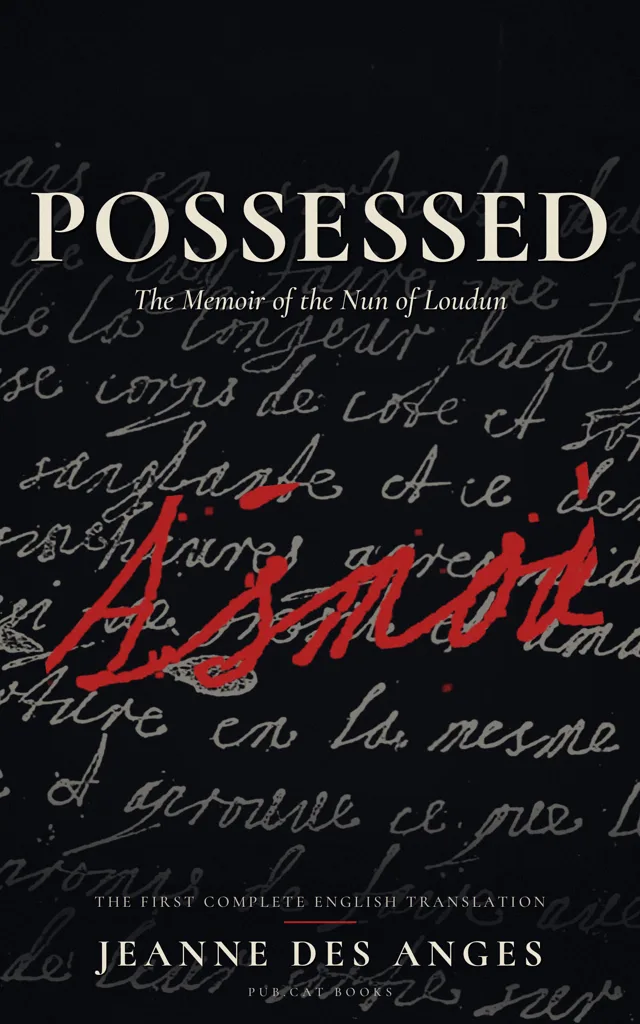
Our newly published book, Possessed: The Memoir of the Nun of Loudun, renders all of this into English: the entirety of her possession narrative, from the opening page to the final one, together with every passage from her later correspondence that the 1886 editors included. To the best of our knowledge, it is the first complete English translation of her autobiography.
Charcot's preface and the editors' own study are omitted, and their diagnosis is not accepted as the explanation. Nor does it adopt the opposing view. It asserts neither that demons possessed the nuns of Loudun nor that an angel restored the names on her hand.
What the book provides is her personal account, reproduced as she wrote it, alongside a dated chronology, a glossary of Church terminology, coins and measures, notes cross-referenced to the pages of the French edition, and images from the period, among them facsimiles of her handwriting.
Should the spectacle be what brings you to Loudun, retellings are easy to find. But if you would prefer to understand how it felt, as she recalled it, to serve as prioress of that convent, with a town looking on, a king summoning her and seven demons to answer for, begin at her opening page.
Pictures: Rijksmuseum (CC0); Wikimedia Commons (public domain); Internet Archive, University of Toronto copy of the 1886 edition (public domain). Quotations are from our translation of the 1886 French printing.