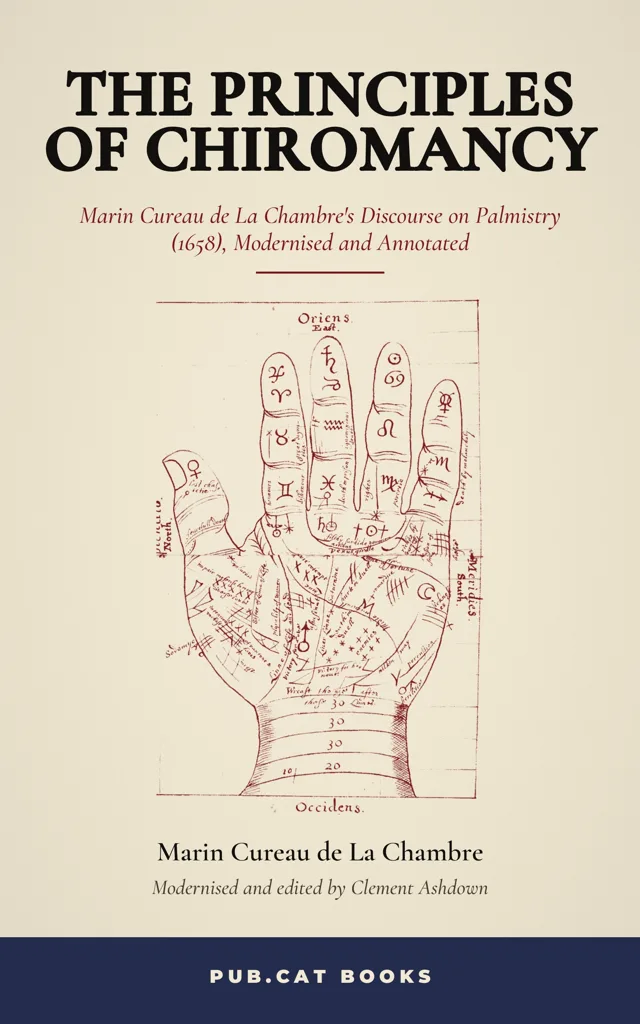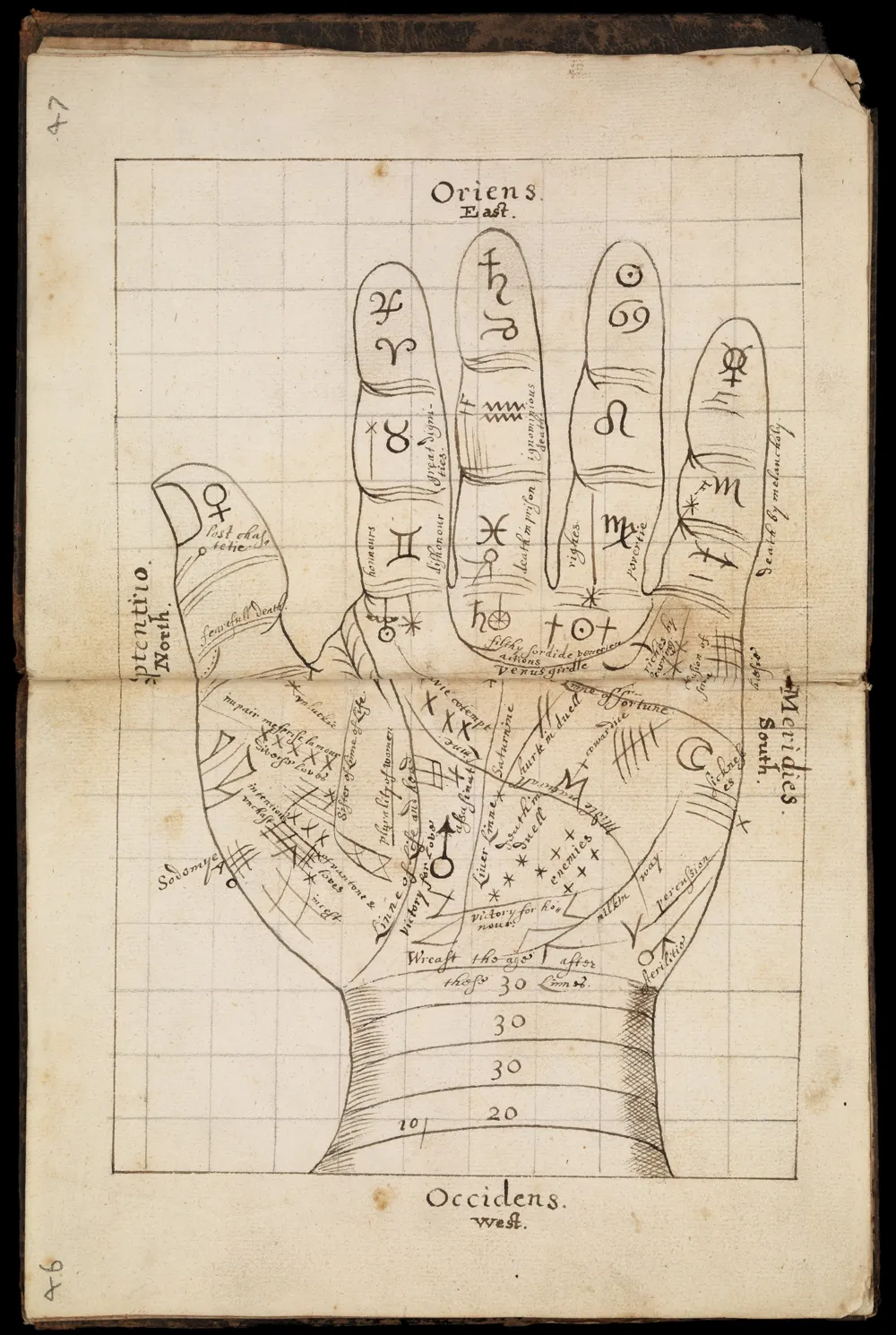
Pick up nearly any palmistry manual and the chances are you will be met with diagrams: a hand, lines marked with labels, an explanation of what a broken life line or a cross beneath the index finger supposedly signifies. The Principles of Chiromancy, published in London in 1658, contains nothing of the kind. There is no chart of the lines, no table of fortunes, no assurance that a stranger will come into your life or that money is heading your way. In its author's view, most such rules were "for the most part false or uncertain, being not verified by just observations".
His question was stranger, and more interesting: did the medicine of his era offer any grounds for thinking that the hand bears signs of what is happening within the body?
A conversation on a walk
The writer was Marin Cureau de La Chambre, a doctor in Paris. Born in Le Mans in 1594, he became physician to Pierre Séguier, Chancellor of France, and was elected to the Académie française on 4th December 1634. He advised and treated two monarchs, Louis XIII and Louis XIV, and the title page of the 1658 English edition describes him as "counsellor to the King of France in his counsels, and his physician in ordinary", that is, a regular member of the medical staff of the royal household. His death came on 29th November 1669.
According to his own account, the book grew out of a conversation. He was walking with a fellow physician called Bejet and fell to talking about palmistry; Bejet enjoyed the discussion so much that he urged him to write it down. La Chambre complied, affecting some reluctance, and dated the letter "From Paris, this first of January, 1653". It appeared in print in Paris that year under the title Discours sur les principes de la chiromance. Five years afterwards a London edition was published as A Discourse on the Principles of Chiromancy, "Englished by a Person of Quality", a courteous way of describing a gentleman who chose to remain anonymous. So far as anyone can tell, his identity has never been established.
Which finger belongs to which planet?
Anyone who has questioned why chiromancers link the index finger with Jupiter and the ring finger with the Sun will find that this is the starting point for La Chambre. The system he set out to account for allotted "Jupiter on the forefinger, called the index, Saturn on the next, the Sun on the third, Mercury on the fourth, Venus on the thumb, and the Moon on its inferior part."
That was not how the heavens were ordered, as any astrologer would have known, and it was this that troubled him. Were the entire system simply a fabrication, he argues, those who devised it would have kept to the sky, just as they did when they assigned planets to the forehead. The departure from that order implied to him that experience had given them no alternative. Some genuine force, he suspected, lay behind the arrangement. Finding out what it was fell to him.
The argument, in three parts
His argument is laid out across twenty-four numbered Articles. In the opening nine he draws on the philosophy of the period to make the case that the hands rank among the body's most noble parts: they draw more heat and "spirits" from the heart, liver and brain than other outward parts do, and nature "never confounds the virtues", assigning each power its own proper place.
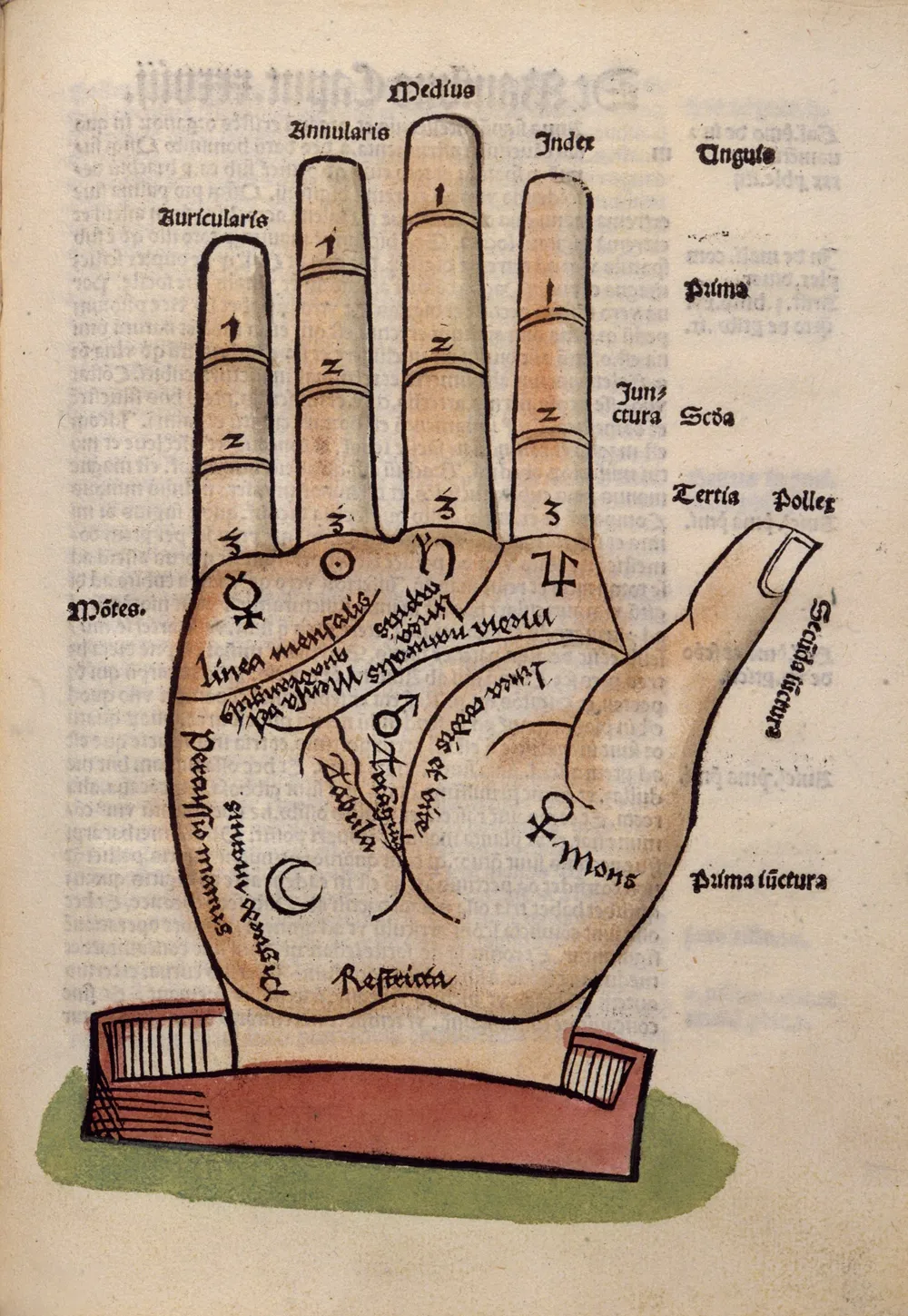
Articles 10 to 18 form the core of the book, and they are the section to turn to first if you have only an hour to spare. A working doctor examines his own clinical records for evidence that specific organs map onto specific fingers: the liver onto the index finger, the heart onto the ring finger and the spleen onto the middle finger. Then Articles 19 to 23 turn to the stars. His argument runs that since the Sun is linked to the heart and the Moon to the brain, the fingers connected to those organs should likewise be linked to those planets.
The surprise comes in the twenty-fourth and final Article. Having drawn a few cautious conclusions, La Chambre steps back. "I do indeed lay the foundation of a science which seems to me sufficiently solid," he writes, "but I do not find materials to finish the building." The rules of palmistry, he concedes, "are not well established", and the field requires "a new provision of observations, which ought to be made with all necessary exactness and certainty". Closing a book on such a topic more candidly than this would be difficult to imagine.
Small things that stay with you
The book's thesis rests on Galenic medicine and an astrological cosmos, and little of that would hold up in a present-day clinic. Its charm lies in the particulars, several of which bear repeating.
The ring finger and the heart. Why is the fourth finger the one we choose for rings? La Chambre offers the ancient explanation: "some, as Appian in Aulus Gellius, say that there is a nerve that proceeds from the heart and ends in that finger." The Roman author Aulus Gellius does recount this in his Attic Nights, although his source is the writer Apion and not the historian Appian, the name having altered somewhere between the original and the London page. Gellius reports Apion's claim that Egyptian anatomists had identified "a very fine nerve" running from that finger of the left hand to the heart. La Chambre goes on to note that when gout affects the hands, "it is the last finger it assaults", and that physicians once used that finger alone to stir their medicines, "whence it is they have called it the medical finger, which the Latin retains".
Over sixty lancet wounds. The book's most intimate admission appears in Article 13, where La Chambre makes the case for opening a small vein on the back of the hand as a treatment for spleen complaints, a practice other physicians had rejected. He draws on his own case records in reply: "having more than threescore times opened that vein in quartan agues, it never failed, after due preparations, either to cause the fever to cease or to make the fits the lighter." A quartan ague was a form of malarial fever recurring every fourth day. Beneath the theory stands a man who bent over more than sixty patients with a lancet and tallied up what happened.
Galen's dream. La Chambre invokes Galen himself to demonstrate that the liver responds to the forefinger. Galen, having been seized by a sharp pain that led him to suspect an abscess on the liver, received advice while asleep to open the artery running along that finger, whereupon the pain ceased immediately. La Chambre's observation supplies the finest detail: reason alone could never have established such a connection, so "it must have been revealed to him in a dream".
Mad horses. Claiming that the Moon holds sway over the brain, he poses the question: "have not horses diseases in the head which bear that name, because both the one and the other of them follow the motions of the Moon?" His reference is to "lunatic". The notion has never quite vanished. Among those who keep horses, "moon blindness" is still spoken of: a recurring inflammation of the eye, so called because the attacks appeared to wax and wane with the Moon.
A poet in disguise. In Article 23, on moles, La Chambre writes that Helen of Troy had a mark between her brows, and he quotes two lines of Latin which he attributes to the Roman writer Cornelius Nepos. Nepos did not write them. They are from a twelfth-century Latin epic on the Trojan War by the English poet Joseph of Exeter, which printers in the sixteenth and seventeenth centuries brought out under Nepos's name. Thus a London book quotes, through a French physician, an Englishman from Exeter got up as a Roman.
Where it sits in the history of palmistry
The timing is notable. English books on the hidden arts thrived in the 1650s, the years of the Commonwealth, and translations made up much of what London readers purchased. Cornelius Agrippa's Three Books of Occult Philosophy was published in English in 1651.
George Wharton brought out Keiromantia in 1652, an English rendering of a Latin work on palmistry. A year later, in 1653, the same year that La Chambre's French original appeared, Richard Saunders issued a substantial illustrated folio covering physiognomy and chiromancy. Such books set out the rules. What La Chambre's slim volume supplied, and none of the others did, was a court physician's enquiry into whether those rules have any foundation whatsoever.
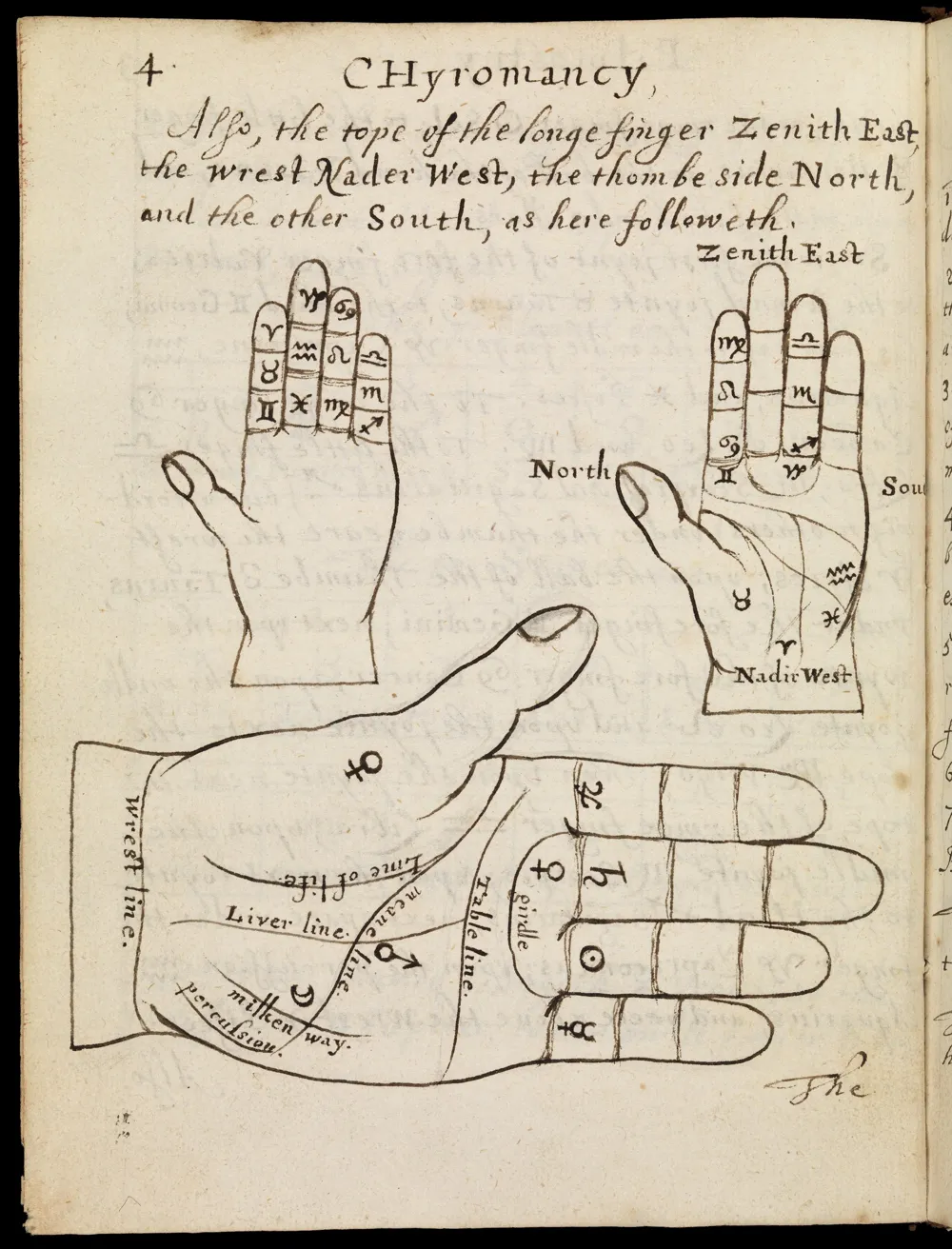
His belief that "the whole man appears in the face" and in the hand survived his medicine and his astrology alike. In 1843, the Frenchman Casimir Stanislas d'Arpentigny contended in La Chirognomonie that the shape of the hand, not its lines, could reveal the mind's tendencies.
William John Warner, the palmist known as "Cheiro", bridged the two traditions: his Language of the Hand was still being reprinted in London in 1958 and in New York in 1962. The law, however, showed La Chambre little of that patience. An English statute of 1530 protested that "Egyptians" were duping the public by "bearing them in hand that they by palmestry could tell men's and women's fortunes".
Reading the book now
Our new publication is The Principles of Chiromancy: the complete 1658 English translation, with its spelling and punctuation brought up to date while every word of the translator is retained. The edition includes a foreword on La Chambre and his position in the history of palmistry and physiognomy, notes attached to each Article explaining the medicine, astrology and philosophy he assumes, a glossary covering palmistry terms, planets, humours and seventeenth-century vocabulary, and a record of all corrections made to the 1658 printing. The text is taken from the Text Creation Partnership transcription of the British Library copy. The three illustrations are earlier palmistry images from the Wellcome Collection, since the 1658 book contains none. To our knowledge, this English version has not previously appeared in a modern edited edition.
This is no palmistry handbook. Rather, it offers a lucid account of how an educated doctor in the 1650s understood the body, the heavens and the boundary between science and superstition, set down by a man bold enough to conclude that the edifice remained incomplete.
Pictures: Wellcome Collection, licensed CC BY 4.0 (https://creativecommons.org/licenses/by/4.0/). The 1658 book itself has no illustrations. Quotations are from the 1658 English translation, spelling modernised.